
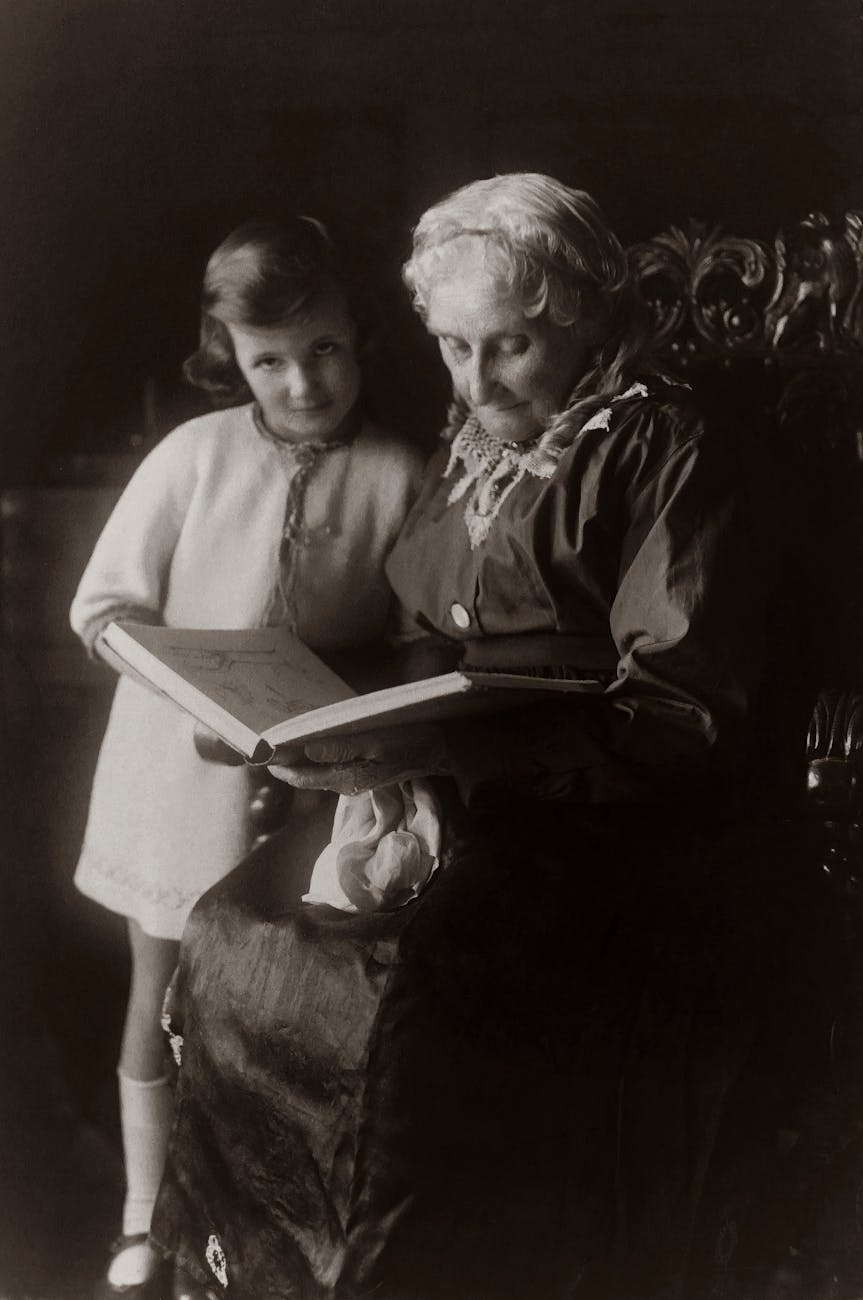
At happy hour last week, a dear friend said something that gave me pause: “My grandparents were all so grumpy and bitter.” And in that moment, I realized that’s exactly how I remember my grandparents—sharp edges, short tempers, cupboards lined with canned goods my mom always said came from surviving the Depression.
Of course they were grumpy. The whole “Greatest” generation came of age in heavy chaos: the Depression followed by World War II.
And then their Baby Boomer children grew up during the civil rights movement, assassinations, Vietnam, Korea. They saw so much. They carried so much. And I’ve been wondering lately if our generation is headed toward the same kind of bitterness.
Jen has been coming home heavy some days, feeling disconnected from her art, her joy, her center. I’ve felt it too—words come out but they don’t sound beautiful or resonant, not like they used to.
We’re definitely NOT in a renaissance right now.
Even the creators I follow who usually radiate woo-woo light have gone quiet. They have been my lifelines this past year as things seem to become more noisy and tangled up and confusing. I realized a few nights ago that I haven’t really seen much new content from them lately. Where did they all go?
The next morning I poured my first cup of coffee and tested a theory at the breakfast table: scroll Instagram reels with the volume off for a .1-second vibe check on each face I saw.
Sad. Angry. Frustrated. Hopeless. Panicked. Afraid.
Pain stacked on pain in their eyes, on their faces…reel after reel, until I put the phone down.
I’m not checking much news or social media these days. I don’t miss it. My students told me Taylor Swift got engaged. Good for her—she looks happy.
But, still, where are all the other happy people right now?
I genuinely want to find out who exactly is thriving in these times.
Today, one of my favorite new teacher friends was cool enough to stop in for a chat and humanize my relatively work-heavy week. She suggested maybe the ’90s were the last renaissance. And, as I drifted into nostalgia of my jr. high and high school days, I’m thinkin’ she might be right.
The ’90s weren’t perfect, but they felt lighter than this. That was the decade that shaped us, right before 9/11 cracked open a new era, before the long stretch of uncertainty—wars, recessions, pandemics, and whatever the history books will eventually call this haunted-ass forest we’re walking through without a map.
Maybe that’s why everyone feels so heavy. For the first time in our generation, we really don’t know what’s coming next. The places that used to feel safe don’t anymore. The storm feels endless, whipped up by fear-mongering, shifting policies, armed guards, unraveling climate, rights disappearing. Everywhere I look, people seem weighed down by uncertainty, distrust, and the feeling of being unsafe.
And so I keep thinking about our grandparents, and about what it takes not to end up grumpy and bitter too. How do we keep the hardness from setting in? I don’t know the full answer.
But I do know this: last night at acupuncture, I felt something release. The tightness I’d been carrying for weeks melted for a little while. My body remembered what it felt like to be lighter, softer, open.
And maybe that’s where hope lives—not in pretending everything is fine, but in letting ourselves feel a moment of release, even just for a breath.
Maybe the best we can do right now is notice the small blips of joy when they arrive–beautiful opportunities for human connection, taking our shoes off in the grass, a big bright beautiful moon in the late summer sky– and hold them like fireflies, trusting they still exist in the dark.
Because even if the world feels haunted and uncertain, our hearts don’t have to hoard bitterness the way our grandparents hoarded cans. They were called the Greatest Generation for how they survived and carried the weight of their times.
But survival isn’t the only form of greatness. Maybe our chance at being great is in how we soften instead of harden, how we stay open, how we keep choosing joy—even in fragments—as proof of life.
