
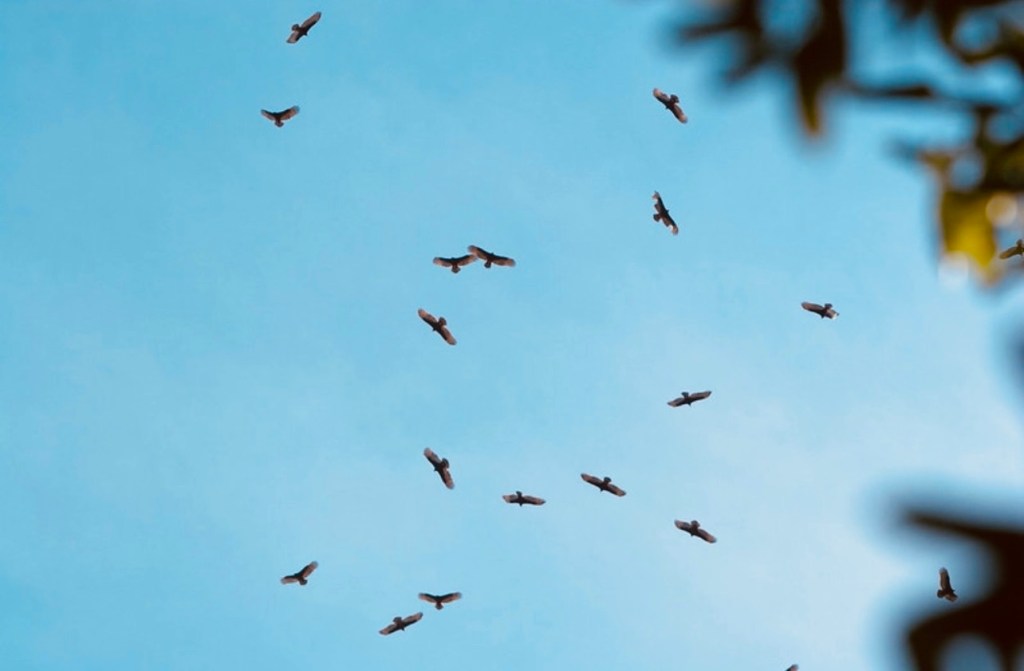
I was driving home from work today when I noticed them again: turkey vultures, enormous and unhurried, riding the air above the road.
Their wingspan always catches me off guard. They don’t flap like they’re in a hurry to be anywhere. They lean into the sky. They trust it. Watching them feels like watching something ancient remember how to breathe.
It reminded me of a morning last week when I looked out into the backyard and saw what must have been fifty of them—circling, swirling, gathering in a great, living churn of wings. They rose and folded into one another, dancing on invisible currents. And then, slowly, one by one, they peeled away, flying south, passing directly over our house as if on purpose. As if to say: notice this.
It was incredible. It felt like magic.
I remember thinking how unfair their name is. Turkey vulture. Gritty. Unglamorous. A word that smells like decay. A scavenger’s reputation slapped onto a creature that looks, in flight, like something carved into a cathedral ceiling. Language does that sometimes, it shrinks what it doesn’t bother to understand.
I later learned that what I saw has a name: a kettle of vultures. When turkey vultures gather and spiral like that, they’re riding columns of warm air called thermals, rising together not out of chaos, but efficiency and trust. A kettle is a shared lift. No one bird expends more energy than necessary. They circle, climb, and when they’re high enough, they break away—alone—carried by what the group helped them reach.
Symbolically, vultures have never been about death in the way we fear it. They’re about transformation. They don’t kill. They clean. They take what would rot and return it to the cycle. In many traditions, they represent patience, renewal, and the strange holiness of things we’d rather not look at for too long. They remind us that nothing is wasted—not time, not loss, not even endings.
A kettle, especially, feels like a lesson: gather when you need lift; leave when it’s time to go. Take turns trusting the air. Rise together. Disperse without resentment.
Standing in my backyard watching them that morning, it felt less like witnessing a flock of scavengers and more like watching a quiet ritual, something ancient, precise, and necessary, unfold above my head.
I was still steeped in that thought when
I pulled up to a stoplight, half in the sky, half in the memory of wings.
And then—
The woman in the car next to me lost her shit.
The light had just turned green. The cars in front of her hesitated for a heartbeat, just long enough to register the change, and she started waving her arms, laying on the horn, her whole body pitching forward with fury. A full nervous system meltdown over two seconds of waiting.
Just like that, I was yanked out of my vulture reverie and dropped back into the world of impatience. Of clenched jaws. Of people vibrating with urgency but not direction.
It made me so sad.
Not at her, exactly, but at how many moments like that sky-full of wings go unseen because we’re so busy grinding our teeth through the day. How often magic passes directly overhead while we’re screaming at a stranger for existing too slowly.
I wish more people could stop and see the nature threaded through our ordinary lives.
Crows fly and perch like street gangs, bold and watchful.
Hawks soar and cry out from eucalyptus trees like they’re announcing something important.
Trees shuffle and twitch together, delighted by the wind, keeping one another company.
There is so much life happening right alongside us. Above us. Around us. Constantly.
Magic is not rare. Attention is.
And I think part of my work in this life, whether I mean to or not, is to keep noticing. To keep pointing upward. To keep asking, Did you see that?
Because if we could just get over our own bullshit for a moment—our urgency, our irritation, our clenched timelines—we might remember that we’re living inside something astonishing.
Even at a stoplight
